Mmmm, the last weekend I did my first trip to a trackday with the 360, and I realise what I think was a tappet noise is clearly pinking
Only appears under charge at low & mid rpms... Stopping at 4200 more or less ( or I don't hear it ). The car have no response to throttle until 4000rpm or so, like it was torqueless... I had think that was the standard specs of the car ( It runs that way since I bought it ), but it feels absolute torqueless.
I use 95ron gasoline and I don't know how are the spark plugs or rotor arm/cap... I'll look at them asap
My feeling is like the car is running a wrong ignition map until 4000rpms, it's possible that the car has a wrong renix module ? From a 1,4 or 1,7 or something ? The car at 4000rpms or higher looks like a normal running, at less rpms, feel very underpowered
Some tips anyone ?!
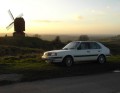
A pic from the trackday to made the topic less boring
For your car it should be labelled 411 A or 411 on the renix unit, easy enough to see on the 2.0 litres as opposed to the 1.4 for sure and probably the 1.7 where it's tucked away!
I had a different one fitted to my car for a day or two, as I was attempting to solve a problem roadside in the dark, and it felt all wrong until it was over 3500 rpm! It just lacked any go! It was from an early 360 carbed car, so no wonder.
Worth checking, as too many people assume that any 300 car will share the same renix unit.
Someone with more knowledge on the possible pinking issues should be along later.
And BTW nice pic from the track day.
Pete
G reg 360 GLT, G reg 340 GL Variomatic, plus many more..........
The B200 E/F engines can take 91 RON fuel no problem at all. B200K's and earlier B19 360s prefer 98 RON unleaded (or 97 RON leaded, if you still have some stashed away somewhere ...)
trabitom99 wrote:The B200 E/F engines can take 91 RON fuel no problem at all. B200K's and earlier B19 360s prefer 98 RON unleaded (or 97 RON leaded, if you still have some stashed away somewhere ...)
CR is what makes requirement in these? As it is in GLT 9.2 vs 10 in GL.
95 is for washing parts, 98 is what burns in engine, this has been my guideline, 98 is not actually more expensive to drive either if engine is possible to adjust to that so it will drink bit less fuel when used 98, also for hard driving I would prefer 98 just to be sure.
Ignore whether it's a B200K or B200E. The compression was lowered for all versions of the B200 from 10:1 to 9.2:1 in 1987 (I think).
10:1 cars need to run 97+ octane to avoid light pinging. That may be what you're experiencing. It'll not make much difference overnight, but the pre-ignition will nibble at your headgasket over time, and the extra heat won't be appriciated either.
EDIT: Those early low-comp figures could be specs for another market. Volvo made the ultra-low compression "camel piss spec" B17 (1.7 redblock) for sale in African markets, which at the time has some very poor quality petrol. Here, at least, they were all 10:1 up to 86/87.
Mine B200(KE) 108 is 10:1 and 1988, my owners manual says it has 10:1
In owners manual there is also B200(KO) 110 that is 9.2:1
Differences are 5nm less torque, 87C thermostat (mine has 92C) and of course this can burn part wash petrol (91 & 92 ROL book says).
Still I would use 98 octane.
One thing I was thinking that could make such sound is con rod bearings, it makes small (not very small when goes real bad) tapping sound and it can get worse quite fast rate.
The more I think about it, I think you're onto something there Jani. It has to be market specific. Certain markets only ever got ultra-low compression engines due to the quality of their petrol.
For the UK market, all B200s were 10:1, then (1987+?) all were 9.2:1, but I'm sure it could have been different elsewhere - it certainly was for the bigger cars.
Usually on the redblocks the rod bearings (little ends, at least) rattle when cold on high mileage engines, but go quiet when warmer. Nessy makes a strange sound, which sounds a bit like ping. It didn't get any better when we put a lower compression B14 in, and doesn't get any better with super unleaded in the tank. Perhaps it isn't ping at all? Wierd...
foggyjames wrote:It has to be market specific. Certain markets only ever got ultra-low compression engines due to the quality of their petrol.
For the UK market, all B200s were 10:1, then (1987+?) all were 9.2:1, but I'm sure it could have been different elsewhere - it certainly was for the bigger cars.
Fuel recommendations / compression ratios may well be different for different markets. AFAIK in England, the lowest grade petrol you get is "Premium 95 RON" unleaded. In Germany however, cars which run on the "Regular 91 RON" stuff are considered as being more economical to run, so car sales / marketing people are quick to point out that a car "läuft mit Normalbenzin".
The specs I listed are copied out of a German-language brochure from 1986.
Ah! Now you see why I'm top of the dioptrins in the "four eyes" thread. The above should read:
1986 B200EA 9,20:1 91 RON leaded / unleaded
1986 B200F 9,20:1 91 RON unleaded
From 1986 onwards we only got the B200EA (Pulsair and EGR exhaust recirculation) and B200F injected 360s. They probably weren't available on all markets, these models were tax-reduced at the time ...
B200E's - as pettaw says.
So meintag, (trying to get back on topic) which engine do you have?
hehe, I didn't post anything 'cause I can't do anything with the car until the weekend... It's a B200E 1989
I'm thinking that the problem would be fuelling too... I've no power in the area of maximum torque demand, maybe dirty fuel filters, a wrong FPR or even a bad readings from the MAF... The car has a maybe too good fuel consumption ( 7,5l / 100 or so )
errr, the ignition can be advanced or retarded in this engine turning the distributor ? maybe would be just a bad ignition timing...
I'll check the basics first, and if I don't see anything maybe I'll go to dyno to get a lambda curve and see how is the powerband...